Supraventricular tachycardia (SVT) stable and unstable
about 3–5 minutes
Question 1 of 11
One of the first things you want to do is
Question 2 of 11
Being able to feel your heart beating is called
Question 3 of 11
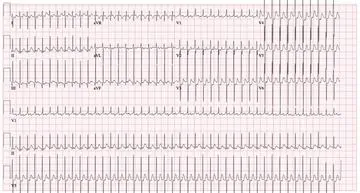
The patient is placed on the cardiac monitor (this rhythm strip). You immediately recognize this rhythm as:
Question 4 of 11
With a blood pressure of 138/84, good color, a pulse oxygenation of 98% and a chief complaint of palpitations, you decide that this patient has
Question 5 of 11
The first step in the treatment of this rhythm would be to
Question 6 of 11
If this does not improve the rhythm, a reasonable next intervention would be
Question 7 of 11
When giving adenosine, it is important to
Question 8 of 11
It is not uncommon for adenosine to cause
Question 9 of 11
While preparing a second dose of adenosine, the patient suddenly loses consciousness. Her radial pulse is extremely fast and weak. You glance at the monitor and realize that her heart rate has increased to over 200. You should prepare immediately to
Question 10 of 11
A fast, narrow complex tachycardia that causes hypotension, chest pain, shortness of breath, or other life-threatening symptoms is referred to as
Question 11 of 11
If the patient remains stable and does not respond to adenosine, other options would include
Get an email copy of your results now, and a reminder when you need to recertify:
Please provide email address.
You scored #%
Correct answers
- Place the patient on a cardiac monitor.
- Palpitations.
- Supraventricular tachycardia.
- Stable supraventricular tachycardia.
- Attempt vagal maneuvers.
- Adenosine 6mg IV fast push.
- Give it fast push followed by a bolus of saline.
- A pause in electrical activity for a brief period of time.
- Perform synchronized cardioversion.
- Unstable supraventricular tachycardia.
- Any of these
Thanks for taking our quiz, now please tell a friend and follow us for more.
Pass 5 quizzes and get 20% off your ACLS recertification
See also
How we reviewed this article
Our experts continually monitor the medical science space, and we update our articles when new information becomes available.
- Current versionMail the author of this pageEmail
- Aug 9, 2026
Copy edited by:
Copy editorsChanges: Added instant feedback to the quizzes.- May 24, 2026
Reviewed by: