ACLS secondary survey: Cardiac arrest assessment
 Written by Judy Haluka
 Reviewed by Jessica Munoz DNP, RN, CEN
Changes: Text updates from medical review
When identifying a pulseless victim, immediately call for help and activate the emergency response system. Start high-quality CPR by pushing at least 2 inches deep and allowing for complete chest recoil at a rate of 100 to 120 compressions per minute. Provide oxygen and attach a monitor/defibrillator as soon as possible. Minimize interruptions in compression. If there is no advanced airway established, follow the 30:2 compression-to-ventilation ratio. If a shockable rhythm (VF/VT) is detected, deliver a shock per the manufacturer's guidelines. Resume chest compressions immediately following a shock and continue for 2 minutes. If no shock is required, continue chest compression for 2 minutes before checking a rhythm. Administer epinephrine 1 mg IV/IO every 3 to 5 minutes. Administer first dose of amiodarone 300 mg IV/IO or first dose of lidocaine 1 to 1.5 mg/kg. The second dose of lidocaine is 0.5 to 0.75 mg/kg.
Consider an advanced airway. If an advanced airway, such as a supraglottic advanced airway or endotracheal airway, is obtained, provide continuous chest compression and ventilations at 1 breath every 6 seconds or 10 breaths per minute. Avoid excessive ventilation and rotate compressors every 2 minutes. Monitor PETCO2 with quantitative waveform capnography and attempt to improve CPR quality with a PETCO2 of less than 10 mmHg. Second and subsequent shocks should be equal to or higher than the previous dose. Consider the reversible causes of Hs and Ts. Signs of return of spontaneous circulation are a pulse and blood pressure, sustained PETCO2 of > 35-45 mmHg or higher, and spontaneous arterial pressure waveforms. Follow post-cardiac arrest care.
For non-shockable rhythms (asystole and PEA), administer epinephrine as early as possible, ideally within 5 minutes of the start of cardiac arrest. Early epinephrine administration in non-shockable rhythms has been shown to improve outcomes.
Printed crash cart cards
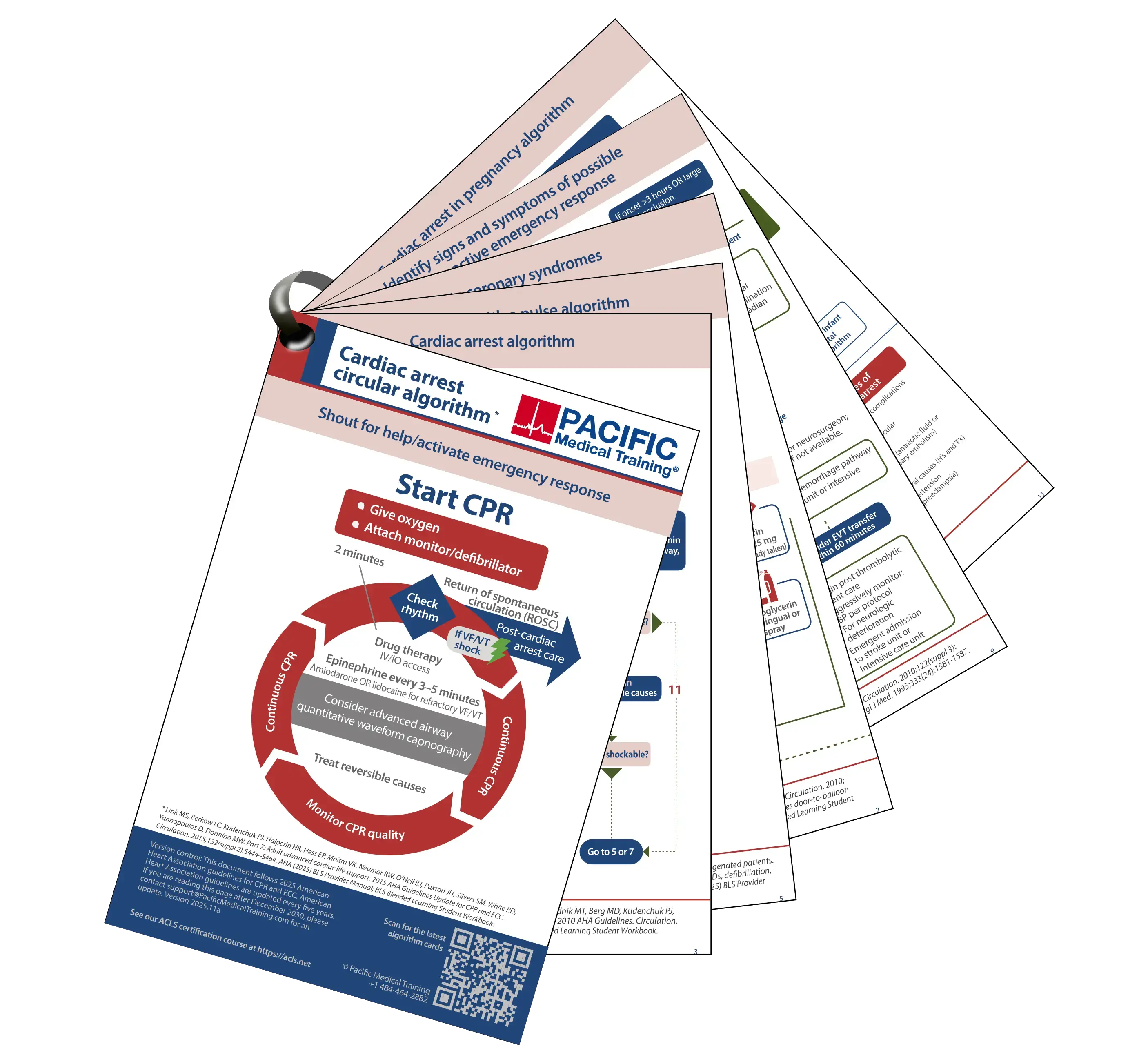
Order the full set of printed crash cart cards.


Planning to certify/recertify ACLS?
Get a reminder when you need to take the exam
Please verify or enter a different email address:
How we reviewed this article
Our experts continually monitor the medical science space, and we update our articles when new information becomes available.
- Current versionMail the author of this pageEmail
- Feb 19, 2026
Copy edited by:
Copy editorsChanges: Text updates from medical review- Feb 17, 2026
Reviewed by:
- Jul 12, 2021
Written by: