Neonatal resuscitation practice (NRP) test
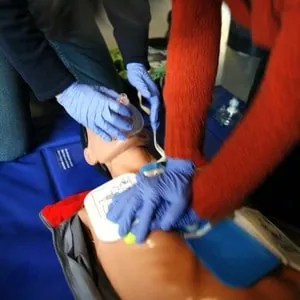
about 3–5 minutes
Question 1 of 10
If a neonate does not begin breathing even after stimulation, you should presume that the baby is in _______ apnea.
Question 2 of 10
Which device should be readily available as a backup whenever resuscitation is required, in case a compressed gas source fails?
Question 3 of 10
Name the part of the sternum where pressure should be applied while performing compressions on the neonate.
Question 4 of 10
When effective ventilation and chest compressions have been provided for 60 seconds and the heart rate remains below 60 bpm, the next step is to ______.
Question 5 of 10
A pneumothorax is when air collects outside the lung in the ____________.
Question 6 of 10
If a pneumothorax causes significant respiratory distress, what apparatus can be used to release the air from the pleural space?
Question 7 of 10
Where can an endotracheal tube end up if inserted too far?
Question 8 of 10
Which of the following is one of the most common conditions that can cause pulmonary hypoplasia?
Question 9 of 10
What is one of the possible consequences of a too-high ventilation pressure and/or rate?
Question 10 of 10
What is the condition in which the pulmonary blood vessels of babies who are hypoxemic and/or acidotic around the time of birth remain constricted?
Get an email copy of your results now, and a reminder when you need to recertify:
Please provide email address.
You scored #%
Correct answers
- secondary
- Self-inflating bag
- Lower third of the sternum
- administer epinephrine
- pleural space
- Percutaneous catheter or needle
- Right mainstem bronchus
- Severe oligohydramnios
- Pneumothorax
- Persistent pulmonary hypertension of the newborn
Thanks for taking our quiz, now please tell a friend and follow us for more.
Pass 5 quizzes and get 20% off your ACLS recertification
How we reviewed this article
Our experts continually monitor the medical science space, and we update our articles when new information becomes available.
- Current versionMail the author of this pageEmail
- May 18, 2026
Copy edited by:
Copy editorsChanges: Updated quiz questions and scenarios- Jun 23, 2020
Written by:
 Elaine Francis
a staff nurse in cardiology and coronary care with NHS since 2009. Formerly Healthwatch Newcastle, Newcastle University, and Northumbria University.
- Dec 10, 2019
Reviewed by:
Elaine Francisa staff nurse in cardiology and coronary care with NHS since 2009. Formerly Healthwatch Newcastle, Newcastle University, and Northumbria University.